FAQs

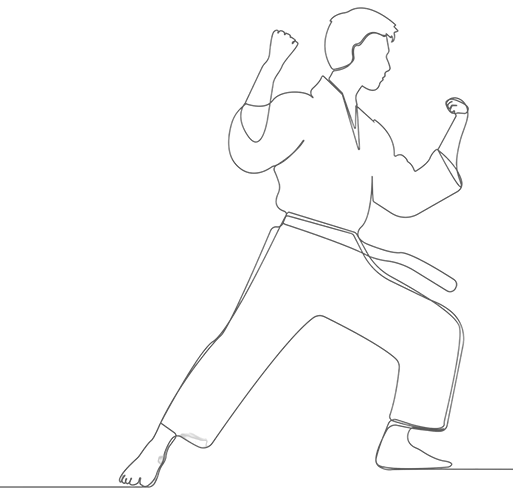
As the term implies it means Military Arts, which essentially means the art and science of attack and defense with and without weapons. Nearly all countries and ethnic groups have in their culture some form of martial art. For example England evolved the science of Pugilism or Boxing; France developed La Savate or Kick Boxing; Russia has Sambo or a form of Throwing and Grappling to its credit. However it was in the far east from India, China and Japan that we have come to what Martial Arts really means. It is a way to better one’s self through discipline, arduous training, with empathy, compassion and respect to one’s self, the art and all others above and below your strata in society.
Originally "KARA" meant "Chinese" and "TE" meant "Hands" or Chinese Hands. However after its introduction in mainland Japan from the island of Okinawa its has been changed to its current meaning and understanding of "KARA" or "Empty" and "TE" or "Hands" or Empty Hands which is another way of saying ‘Un-Armed Combat". Today it is termed as "KARATE-DO" or the "Way of the Empty Hand".
Karate-do evolved in the islands of Okinawa under Japanese Sovereignty, and was influenced by the Chinese styles of "Kung Fu" from the Shaolin Monasteries. Hence four main styles evolved and are still practiced today and are Shoto Kan; Shito Ryu; Wado Ryu & Goju Ryu. However, today there are many sub divisions within each style and in fact in Mumbai alone there are 9 different styles of GOJU RYU alone, all officially represented to their parent Organizations in Japan.
The main difference is not in the styles but rather if the Karate-do Institute is teaching Sports Karate or Traditional Karate-do. If it is the former then all students are taught sports Karate which dilutes the true meaning of Karate-do, and would probably mean the end of their training after 30 years of age. If it is the latter then in all probability this Karate-do Institute would concentrate on a high level of Fitness and Un-armed combat, and enable the student to train even in his Eighties like our teachers in Okinawa
There is NO best or most dangerous style. Remember, "Styles" do not Fight - People do. It's the Man/Woman that makes the style and not the other way around.
Traditional Karate-do training emphasizes a very high level of fitness and teaches its students all the intricacies of Self- Defense. It also teaches patience, compassion, humility, empathy, and the ability to laugh in the face of adversity, and a never say die attitude. In short it makes a better person out of you.
Karate-do is contact oriented and sooner or later accidents are bound to happen. However most Karate-do schools (like ours) do semi contact sparring where the attacks are highly controlled. Some schools profess to teach full contact and here the chances of injuries increase exponentially.
Before choosing a school, visit as many as you can before deciding which one to join, since choosing the school that’s right for you could change your life.
This is entirely dependent on each individual. In our Dojo (Karate-do school) we have more than 20 Black Belts who still come for training even after 10; 20 & 30 years or more.
All Karate Institutions have their own system of Grading. There are two main Categories. The student section (KYU) and the Master Section (DAN). In the Kyu category there are normally 10 levels commencing from a white belt to a senior Brown Belt and begin from a descending order. The Dan levels begin from an ascending order starting from 1 and ending at the 10th. Dan Level. Each level has an examination and on passing the student is promoted to the next level. It takes about 3 to 4 years to reach the coveted Black Belt 1st. Dan or SHO DAN. On par with academics; this would be equivalent to a Matriculation.
For Kids and youngsters Competition is important and should be encouraged. But it should not be the primary and only aspect of training.
A Karate-do Instructor in India should have an affiliation or registration with a Internationally recognized style Organization abroad, usually from Japan. He should be at least a 3rd. Degree Black Belt and have the license to teach and grade his students in India. In most karate-do Federations, a 3rd. Degree Black Belt would only be allowed to grade his students upto a 1st. Degree Black belt. He should also be well versed in physical training as well as having a First Aid Certification.