History
6th Century A.D.
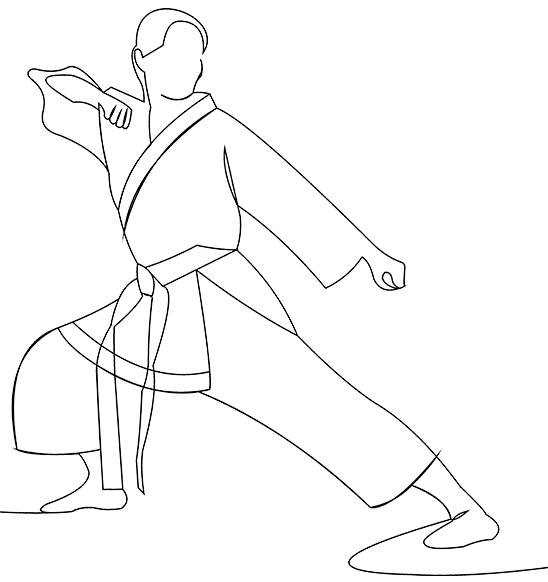
The origin of karate dates back to more than a thousand years probably to the 6 century A.D. There has been a debate as to the true origin of the Asian martial arts. One school of thought places the origin in ancient China while other sources place the beginnings of this ancient art in India. A monk, Bodhidharma, travelled overland from India to China across the Himalayan mountains and settled the Hunan province in China.
He established the Shao Lin monastery and began teaching Zen Buddhism and many believe him to be the Father of this cult. He developed a series of fighting techniques in which the monks trained to become both physically and mentally stronger and the right discipline that was part of their practice helped them build endurance and tremendous physical strength. Soon the monks became formidable warriors.
The Ryukyu Islands
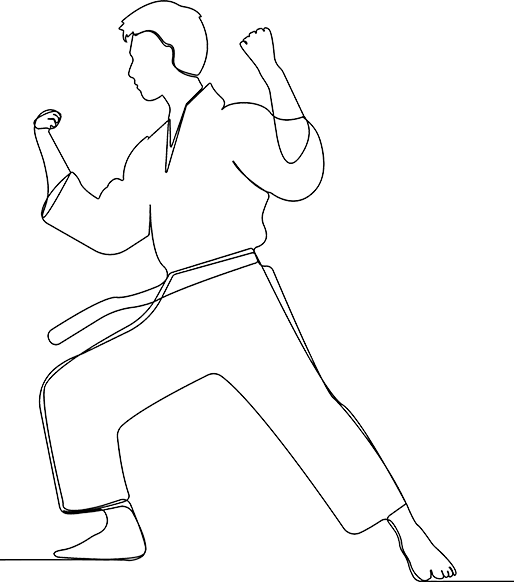
Over many years, these monks scattered all over China and wherever they settled, they took with them this knowledge and began teaching others. As merchant trade developed between China and the Ryukyu Islands, of which Okinawa is the largest, these techniques were transmitted from the Chinese to the Okinawans. The Lord of Okinawa had banned the use of weapons in his land which gave rise to the development of the 'empty hand' fighting and self defence techniques.
The Okinawans merged this new found knowledge with the already existing combative techniques indigenous to Okinawa known as 'Te' which later split into three main styles:
These techniques came respectively from the three areas of Okinawa i.e. Shuri, Naha & Tomari.
20th Century A.D.
By the end of the 19" century, Shuri-te and Tomari-te were subsumed under the name Shorin-ryu, which during the years developed into several slightly different styles. Naha-te came to be known by the name Goju-Ryu (the hard and the soft style) and has remained thus since. These skills remained in Okinawa, passed on from generation to generation and in 1922, Karate was taken to Japan by Gichin Funakoshi. Karate flourished in Japan and it is from here that it spread throughout the world. So virtually, all known styles of karate have evolved from the ones in Okinawa.
To the layman, karate may mean a martial art. But to the master, karate is a means of building character. A student of karate must render his mind empty of selfishness and wickedness in an effort to react appropriately toward anything he might encounter. This is the true meaning of 'Kara' or 'empty' in karate. Thus this martial art, because of its Chinese origin, got its name karate-' Karate-do translated means 'the way of empty hand'.
Bodhidharma was a Buddhist monk who lived in the 6th century and is said to be the patriarch of all martial arts. However few fighting arts have a deep and fascinating history as that of Okinawan Goju-ryu Karate-do. From Shaolin temple and Chinese boxing origins, to the style of Naha-te, its further development into Okinawan Goju-ryu and the formation of the International Okinawan Goju-ryu Karate-do Federation, the history of our art spans hundreds of years. Passed from Master to student, the art was trained and the history was transmitted orally.
In the late 20th century Sensei Morio Higaonna documented this information into the now famous Goju-ryu text book: The History of Karate.
All the history documented below comes directly from The History of Karate and Sensei Higaonna's lifelong research into the subject…
Kanryo Higaonna was born on March 10th, 1853 in Nishimura, Okinawa. He was one of eight siblings and his family were of a lower economic class. Kanryo Higaonna's father was a sailor and he made his living shipping and trading items between the Ryukyu chain of islands and further afield to China. Upon his return he would always tell stories of the marvels of China and their martial arts. At the age of 10, Kanryo Higaonna began assisting his father with his work on the boats. In 1867 when Kanryo Higaonna was 14, his father was killed in a fight, the reason for which still remains unknown. This was a terrible blow to the family, especially to a young Kanryo Higaonna and his focus quickly turned from grief to revenge. He made the decision to travel to China to learn the deadly fighting arts and return to extract revenge on his father's killer.
He arrived in the port of Fuzhou in Southern China and once there sought out other Okinawan's living in the area. He questioned them about great martial arts masters living in Fuzhou. Introductions were organised and Kanryo Higaonna was introduced to his eventual teacher; a man named Ryu Ryu Ko. Ryu Ryu Ko accepted the young teenager and made him swear an oath to follow his philosophies, principles and to promise never to misuse the martial arts he would learn.
Kanryo Higaonna would arrive at Ryu Ryu Ko's house every morning. He would assist his teacher in his work as a bamboo craftsman, cutting and carting bamboo and making all manner of things out of it. Ryu Ryu Ko lived in a two-story dwelling. The top floor was his house; the bottom his workshop and all training took place outside in the garden. Through many hours of hard training and through his dedicated assistance with his teacher's work, Kanryo Higaonna eventually became a 'live in' student. He took up residence inside his teacher's home and dedicated every waking moment to his master. He endured much hardship through the often brutal training and quickly developed an unbelievable level of power, strength and speed. He also learned about herbal medicines and studied the use of weapons.
After 14 years of loyal study, Ryu Ryu Ko had grown older and told Kanryo Higaonna it was time for him to return to his homeland of Okinawa. In 1891 the two parted ways as Kanryo Higaonna followed the wishes of his master and they were never to see each other again. Kanryo Higaonna left China an accomplished martial artist and with 9 of the current Goju-ryu kata. Upon returning to Okinawa, his father's killer heard of the great martial arts skills Kanryo Higaonna now possessed. The killer begged him for forgiveness and remembering the oath he had made to his master, he very graciously forgave the man.
Kanryo Higaonna continued his training in Okinawa, firstly on his own and then eventually began teaching students in his home. He called his martial art Naha-te after the capital city of Okinawa where he was based and following the example of the other main Okinawan styles of the time: Shuri-te and Tomari-te. He also eventually took a position as a karate instructor at the Naha commercial high school in 1905.
Chojun Miyagi was born on April 25th, 1888. He was born into a wealthy family, but as a youth was at times unruly. At the age of 11 he was taken to Ryuko Aragaki (the grandfather of Goju-ryu Master Shuichi Aragaki, IOGKF Technical Advisor), who was 24 at the time, to learn karate from him in hopes to instil discipline in the mischievous boy. Chojun Miyagi immediately developed a love for karate and became a very serious student. Aragaki recognised this and decided that he needed to study under a strict teacher, whose karate was second to none, to unlock Chojun Miyagi's full potential.
In 1902 at the age of 14 he was taken and introduced to Kanryo Higaonna and was accepted as a student. Kanryo Sensei was 49 years old at this point and known by the nick name 'Ashi no Higaonna' (meaning "Legs" Higaonna) because of his exceptionally strong legs. Although warned of the severity of the training, Chojun Miyagi's expectations were far exceeded when he began his training in Naha-te. The training he received was intense and very brutal and he trained extra outside of his classes to strengthen his body to aid in his fast improvement. Kanryo Sensei observed this and eventually Chojun Sensei became the student he chose to learn the entire art of Naha-te. At the time, students only learned Sanchin and one other kata. Training took place at the Kanryo Sensei's home each evening and after the usual two-hour session, Kanryo Sensei would keep Chojun Miyagi behind for personal one on one instruction in the entire system.
In 1910 World War I swept across the globe and Chojun Miyagi was called upon for mandatory military service. He became a soldier at the age of 20 and was discharged at the age of 22. He rushed back home to Okinawa upon hearing that his teacher's health had deteriorated. Chojun Miyagi desperately wanted to learn the rest of the Naha-te style from his teacher and also care for him in his later years. Everyday Chojun Miyagi would bring Kanryo Sensei to his own home to care for and learn from him. He became the only student to learn all the Naha-te kata from Kanryo Sensei, who passed away three years later in 1915. Many Okinawans referred to Kanryo Higaonna by the title of Bushi, meaning a distinguished master of the martial arts. Also in 1915, Chojun Miyagi fulfilled the final wish his teacher had for him and made the trip to Fuzhou in China. He travelled by boat on the same route Kanryo Sensei had many years before him. He explored and researched the area, visiting the house of Ryu Ryu Ko and demonstrating the kata he had learned to an old man who was a student of Ryu Ryu Ko. During his two months stay, Chojun Miyagi recorded much information about Ryu Ryu Ko.
Upon his return to Okinawa, he was now 29 years old and he took his teacher's place and began teaching Naha-te. He worked to further develop the fighting system he had inherited. Chojun Sensei had learned the kata Rokkishu in China and his further development of this resulted in the creation of Tensho Kata. He also researched and created warm up exercises for the body. Furthermore, Chojun Miyagi revised Sanchin Kata to be performed in a straight line, moving both forward and backwards, instead of turning around. He taught out of both his home, the now famous Garden Dojo, and also at a space he rented at the Naha Commercial High School.
The local police force became concerned about Chojun Miyagi's reputation and warned him of the consequences of misusing karate. Chojun Miyagi explained the true nature of his teachings, and in doing so he was hired to teach at the Okinawan Police academy. In 1926 Chojun Miyagi founded the Karate Kenkyu Club, bringing together the top Masters of the main styles of karate to unite under the common goal of spreading true karate to future generations. The Masters in this club were Chojun Miyagi, Chomo Hanashiro, Choyu Motobu and Kenwa Mabuni.
In 1930 an invitation was received to perform a demonstration in Tokyo at the celebration of Crown Prince Hirohito's succession to the throne. Chojun Miyagi couldn't attend, but instead sent his top student, Jin'an Shinzato, in his place. After Shinzato's demonstration, he was asked by someone who viewed his performance what the name of his style was. Shinzato wasn't sure how to answer, as Naha-te was more of an informal name. He related this story to Chojun Miyagi who thought long and hard about this and on what to name his karate style. Within the famous martial arts text, the Bubishi, is a poem called the Kenpo Haku (the eight poems of the fist) and Chojun Sensei was quite fond of it:
The third poem, 'Ho Go Ju donto', is where Chojun Miyagi took the name 'Go Ju'. He then added 'Ryu' to the name to formally name the style Goju-ryu (literally meaning Hard and Soft Style) in 1930. Chojun Miyagi began promoting Goju-ryu Karate even more heavily. In 1934 he spent almost a full year teaching Goju-ryu Karate in Hawaii. He also performed demonstrations on the Japanese mainland to popularize karate. In 1940 he created and added two new kata to the Goju-ryu system, Gekisai Dai Ichi and Gekisai Dai Ni. He wanted karate to be more accessible to people of all ages and wanted a basic kata to make training more popular – Chojun Miyagi's Gekisai Katas succeeded in doing this.
His promotional work to spread Goju-ryu was so successful that the Japanese Butokukai recognised his style as an official martial art and he as its official master. Chojun Sensei's legendary Goju-ryu grip also earned him the nickname 'Nukitui Magushiku' for his ability to tear raw meat apart with his bare hands and he became quite famous for this in Okinawa.
World War II then cast its shadow over the world and towards the end of the war, the Battle of Okinawa took place and along with it the slaughter of thousands of Okinawans. Chojun Miyagi and most of his family were lucky to escape to the north of the island, however many of his students were not. Jin'an Shinzato's death in particular was a great loss to Chojun Miyagi and suddenly the future of his karate was uncertain. Once the war was over, he returned to Naha to find that a majority of the city had been destroyed and that his historical records on Ryu Ryu Ko had been wiped out and lost forever. It was a desperate time for the survival of Goju-ryu and Okinawa.
Anichi Miyagi was born on February 9th, 1931. He lost both of his parents during the Battle of Okinawa in World War II, when he was only 14 years of age – he was the only one left to provide for his two younger brothers. Anichi Miyagi had heard of the legendary Chojun Miyagi Sensei through a friend. The two decided to go to the home of Chojun Sensei to ask for permission to study karate under him. Chojun Sensei had lost a majority of his students during the World War II. He knew times were changing and that he was growing older. On February 1st, 1948 Chojun Sensei accepted Anichi Miyagi and four of his friends as students and their training began first inside his house and eventually outside in the now famous Garden Dojo.
The four young men were put through Chojun Sensei's grueling warm up exercises, basic training and supplementary practices. There was no room for error in the movements and Chojun Sensei was strict on all of them. The training was so intense that after one year only Anichi Miyagi remained out of the small group. Chojun Miyagi Sensei was getting older and began to contemplate how his style was going to survive. He still instructed in the same manner of his teacher, only teaching Sanchin and one suitable kata to each student. He knew for Goju-ryu Karate to survive, he would need to pass on the entire system to someone. Anichi Miyagi was only 16 years old when he began his karate practice. He dedicated himself to his master's teachings and became like a son to Chojun Miyagi Sensei.
Chojun Sensei tested Anichi's character by having him perform chores around the house, such as weeding the garden and cleaning the yard for training. His attitude was observed and Chojun Sensei decided that the young Anichi Miyagi was the one to inherit Goju-ryu from him. During this period of one-on-one instruction at the Garden Dojo, Ryuko Aragaki (Chojun Miyagi's first teacher) visited unexpectedly one day. He asked Chojun Sensei to accept his grandson, Shuichi Aragaki, as a student. Even though he was not planning on taking any more students at this crucial point in his life, Chojun Sensei couldn't turn down his first Sensei and accepted Shuichi Aragaki as a student.
Anichi Miyagi and Shuichi Aragaki began training together under Chojun Miyagi Sensei at the Garden Dojo. Later other students began training at the Garden Dojo also, including Tsunetaka Shimabukuro and Anichi Miyagi's youngest brother. Despite this, it was only Anichi Miyagi who learned all the Goju-ryu Kata, applications and the remainder of the system directly from Chojun Miyagi Sensei and he also had much of the early history of Goju-ryu passed onto him orally, by his teacher.
By mid-1953 Chojun Sensei's health was deteriorating rapidly. Life was extremely hard following the war; however, Chojun Sensei made a point of still instructing Anichi Miyagi every evening. In October of that year, Chojun Miyagi Sensei passed away. Anichi Miyagi heard this from a friend who had heard the news over the radio and rushed to Chojun Sensei's Tsuboya home, where a large grieving crowd had gathered. He entered the house to pay his last respects to Chojun Miyagi Sensei, who now also had received the title of 'Bushi' from many people. Anichi Miyagi was the last person ever taught by Chojun Miyagi Bushi. The treasure of Okinawan Goju-ryu Karate had now forever been placed into the hands of Anichi Miyagi for safe keeping.
Morio Higaonna was born on December 25th, 1938. At the age of 14 he began his martial arts training with his father who was a Shorin-ryu Karate practitioner. By the age of 15 he joined Naha Commercial High School Karate Club and became friends with Tsunetaka Shimabukuro, who was a student of Chojun Miyagi Sensei for two years. Shimabukuro taught Morio Higaonna Sanchin, Gekisai, Saifa and Seiyunchin Kata's. Shimabukuro encouraged him to go and see the Garden Dojo and undertake the training of Goju-ryu Karate. The necessary introductions were made and in April 1955 at the age of 16, Morio Higaonna officially entered the Garden Dojo of Chojun Miyagi. In the period since Chojun Miyagi Sensei's death, training had resumed at the Garden Dojo. Eiichi Miyazato was elected the dojo head, Koshin Iha was in charge of collecting fees and Anichi Miyagi Sensei was the class instructor. Koshin Iha quickly pointed out to Morio Higaonna that Anichi Sensei was the most knowledgeable and that he should go and learn from him.
Morio Higaonna was devoted to trying to win the respect and teachings of Anichi Miyagi Sensei and he trained at the dojo six days per week and on Sunday's would train on his own at this home. This is when he really began to develop his now famous passion and energy for karate. Anichi Sensei recognised the dedication in Morio Higaonna and would on occasion ask him to accompany him to Chojun Sensei's house on a Sunday to do chores for the founder's family and tend to the dojo. Anichi Sensei had an overwhelming effect on Morio Higaonna, a dedication which continues to this day.
In 1957 Morio Higaonna took a job at a local bank, but resigned shortly afterwards, as the busy work schedule was interfering with his karate training with Anichi Sensei. Later the same year it was decided that a more permanent dojo was needed away from Chojun Sensei's home. The Jundokan Dojo was built and all classes moved to that location. Anichi Miyagi Sensei and Morio Higaonna transported all the equipment from the Garden Dojo to the new location and also dug the holes for the many makiwara in the side yard of the new premises. Anichi Miyagi continued to do the majority of the instruction during this time.
As Anichi Sensei gained a good job on an American oil tanker, his work took him overseas. Morio Higaonna decided it was time to broaden his own horizons and he moved to Tokyo to study at Takushoku University. As time went by Morio Higaonna was invited to teach Goju-ryu at a small dojo in the Yoyogi district of Tokyo. His reputation as an exceptional martial artist grew fast and many Japanese people and foreign visitors were seeking out his instruction. A famous martial arts historian who had visited dojo's all over mainland Japan made the comment that there was no one in Japan like Morio Higaonna and that he was 'the most dangerous man in Japan in a real fight'.
By 1979 Morio Higaonna had a worldwide following. With the blessing of Anichi Miyagi Sensei and other senior students and family members of Goju-ryu founder Chojun Miyagi Sensei, he formed the International Okinawan Goju-ryu Karate-do Federation (IOGKF) in 1979 in Poole, England. Morio Higaonna was appointed World Chief Instructor and both Anichi Miyagi Sensei and Shuichi Aragaki Sensei were part of the advisory team overseeing IOGKF. Morio Higaonna continued to travel the world, teaching large seminars everywhere he went. As the IOGKF grew larger and Goju-ryu Karate became more popular and spread across the world, the dream of Chojun Miyagi Sensei had been fulfilled.
International demand for the teachings of Morio Higaonna grew also and he was teaching in up to 15 countries per year. He moved to San Marcos, California (USA) and set up the then IOGKF Honbu Dojo in the same area in 1987. He remained in the United States until 1995, when a move back to Japan brought with it the opening of the Ryubukan Dojo in Tokyo. Two years later, in 1997, IOGKF International became a recognized part of the Nihon Kobudo Kyokai (Japan Traditional Martial arts association). This membership placed official recognition by association that Goju-ryu, as taught by IOGKF International, was a true traditional martial art.
Anichi Miyagi Sensei sadly passed away in September 2009. However, before his death, he presented Morio Higaonna Sensei with his own personal Black Belt, his 10th Dan Certificate and another certificate recognising him as the heir to the Goju-ryu in the direct line to Chojun Miyagi Sensei. Shuichi Aragaki Sensei also signed this certificate. May 2013 saw further recognition of the Goju-ryu Masters life's work, when Morio Higaonna Sensei received an award from the Okinawan government listing him as Intangible Cultural treasure. His efforts to share and spread Okinawan culture with the rest of the world had not gone unnoticed. Over the years Higaonna Sensei's many research trips to China saw him build important relationships with Okinawa's martial arts ancestors. He conducted research on such trips to capture the origins of Goju-ryu karate which in turn brought about the production of his numerous best-selling books, videos and DVDs. Morio Higaonna Sensei has ensured that the history of karate will always be available for future generations and that its culture will continue to spread across the globe, making him extremely worthy of Okinawa's highest honour.
Today, having set foot in over 70 countries and having provided Karate instruction to millions, Morio Higaonna Sensei resides in Okinawa, not far from the home of Goju-ryu founder Chojun Miyagi Bushi. Media crews from all the world including the BBC, History Channel, Russian Martial arts Channels, Japan NHK, and other documentary teams still regularly travel to Higaonna Dojo to try and capture the essence of Higaonna Sensei's inspiring lifetimes work and to share it with the world. Every fourth year however, Higaonna Sensei hosts the World Budosai, a martial arts festival that brings the world to him. Over one thousand people attend each Budosai and experience the true roots of Goju-ryu karate from its highest master.
Tetsuji Nakamura was born on April 3rd, 1965 in Osaka, Japan. His first encounter with martial arts was at the age of 12 years old and by the time he was 15 he was practicing karate at a local club. He earned a 2nd Dan in judo through his training and when he arrived at Kagawa University for his studies he joined the karate club there also. During a university break, he told the club instructor that he was going to take a vacation with some friends to Okinawa. Delighted to hear this, the club instructor insisted that Tetsuji Nakamura call his own sensei while he was there to show his respect. Upon arriving in Okinawa, when Tetsuji Nakamura picked up the phone he had no idea he was about to call Shuichi Aragaki Sensei (student of Chojun Miyagi Sensei and an IOGKF advisor). Aragaki Sensei invited Tetsuji Nakamura to his house for dinner and relayed to him many stories about Chojun Miyagi Sensei and his own experiences in karate.
These stories stayed firmly in the mind of Tetsuji Nakamura once he returned to university on the mainland. He decided he needed to know more about this style of karate and returned to Okinawa to meet with Aragaki Sensei again, who insisted they train together. Aragaki Sensei's power and precision scared the young Tetsuji Nakamura and upon graduating university with a degree in law and politics he decided he must once again return to Okinawa. He arrived at Aragaki Sensei's house, where he was informed Aragaki Sensei did not have the time to instruct him. Instead Tetsuji Nakamura was taken to the Higaonna Karate Dojo in the Makishi district, near Tsuboya, in Naha. Here Aragaki Sensei showed him how to perform all the supplementary training of Goju-ryu and told him to do so every day. Tetsuji Nakamura obeyed and as days turned to weeks and weeks turned to months he began to wonder if Aragaki Sensei would ever return.
Six months later, Aragaki Sensei arrived at the dojo and determined that Tetsuji Nakamura's loyalty and efforts were worthy of the best Goju-ryu instruction. In 1991 Tetsuji Nakamura won the IOGKF World Championships and Morio Higaonna Sensei saw the dedication and potential in the young man and asked Tetsuji Nakamura to accompany him back to San Marcos in America, where he was then based.
He quickly became Higaonna Sensei's top student, training at home with him daily in his private garage dojo and then every afternoon and evening at the then IOGKF Honbu Dojo. He also became an assistant instructor at the dojo and an assistant administrator in the IOGKF Head office. Tetsuji Nakamura also featured in the famous Goju-ryu film 'Power Training' as Higaonna Sensei's partner. When Higaonna Sensei decided to move back to Japan and set up a base in Tokyo, Tetsuji Nakamura followed him and remained in the capital with his sensei for three years.
He moved to Canada in 1997, married his wife Rania in 2000 and they had their first child in 2002, the same year he took over as Administrative Director for IOGKF International. His family moved back to Okinawa for another twelve months so he could undertake this new role. Tetsuji Nakamura moved back to Canada following this and established Shudokan, the current IOGKF International Honbu Dojo. In 2012 at the IOGKF World Budosai, Higaonna Sensei decided to retire from his role of World Chief Instructor in IOGKF to take Anichi Sensei's old position as Supreme Master and appointed Sensei Tetsuji Nakamura as his replacement. In 2022 at the age of 84, Higaonna Sensei stepped down from his role as Supreme Master and from IOGKF.
Today IOGKF International has over 75,000 members in over 60 different countries. Tetsuji Nakamura Sensei leads the Federation and protects the cultural treasure that is Okinawan Goju-ryu Karate-do with the goal of passing it to future generations.
Anyone can learn the true art of Chojun Miyagi and those before him through the legacy handed down to Tetsuji Nakamura Sensei. Okinawan Goju-ryu is alive today and stronger than ever thanks to the sacrifices, effort and commitment of all the masters of IOGKF's lineage. The goal of training remains the same as it did in the days of the founder, to develop people of strong character, morals and discipline to create a better society for all of us.
The International Okinawan Goju-Ryu Karate-Do Federation (IOGKF)
was established in July 1979 by Morio Higaonna Sensei.
The IOGKF was established for the purpose of protecting and preserving traditional Okinawan Goju-Ryu Karate-Do as an intangible cultural treasure in its original form as passed on by Goju-Ryu founder Chojun Miyagi, and to spread this art throughout the nations of the world. Most importantly, the IOGKF was formed with the support and backing of Ken Miyagi (fourth son of Goju-Ryu founder Chojun Miyagi), An'ichi Miyagi (successor to Chojun Miyagi) and senior students of the late Chojun Miyagi: Seiko Kina, Seijin Nakamoto, Kiei Tomoyose, Shunshin Furugen, Jitsuei Yogi, and Shuichi Aragaki.
Since its formation, the IOGKF has grown to have more than 55 affiliated countries and over 75,000 members worldwide. Every year gasshuku (training seminars) are held in various countries to ensure the transmission of correct techniques and to promote friendship and exchange between members. The IOGKF is one of the few karate organizations that the Japanese Government recognizes as a true Japanese traditional martial arts organization. The IOGKF is a proud member of the Nihon Kobudo Kyokai (Japan Traditional Martial Arts Association).
In 2012 Higaonna Sensei took up an advisory role within the Federation and appointed Sensei Tetsuji Nakamura as his successor and chief instructor of IOGKF International. Sensei Ernie Molyneux and Sensei Henrik Larsen were also promoted to IOGKF Vice Chief Instructor at the same time and together the three formed the IOGKF International executive committee. In 2022 at the age of 84, Higaonna Sensei stood down from his role in IOGKF.
Today the IOGKF is as dedicated to its original purpose as it was in 1979. The IOGKF represents the philosophy of Goju-Ryu founder "Bushi" Chojun Miyagi, and with this in mind, Higaonna Sensei reminds us that it is important to dedicate ourselves to the further improvement and development of Goju-Ryu karate through diligent training, so that we may come to understand the very essence of our art.
IOGKF International Honbu Dojo is located in Burlington, Ontario, Canada where Sensei Tetsuji Nakamura resides.

(1853 - 1915)
Please note that owing to the different ways Japanese can be translated into English you may often see Kanryo Hiagaonna referred to as Higashionna Kanryo.
Kanryo Higaonna was born in Naha, Okinawa in 1853, he was one of eight children. His father made his living trading firewood between the local islands. Kanryo Sensei helped his father from the age of ten, and the hard work made him very strong. From childhood Kanryo Higaonna showed great interest in the fighting arts and was eager to learn as much as possible. By all accounts he was known for being very supple and quick on his feet, despite his small size.
At age fourteen Kanryo Higaonna began to learn Chinese Kempo. His well developed and strong body enabled him to master Chinese Kempo and he quickly built a reputation as a martial artist in Naha. Unsatisfied with his level of skill, Kanryo Higaonna longed to go to China to study the Chinese martial arts and their culture. Unfortunately, his family´s financial circumstances were unable to offer him the freedom to travel.
As chance would have it, Higaonna Sensei's instructor introduced him to Udon Yoshimura, a ship-owner in the port city of Naha. It was Udon Yoshimura who eventually sponsored Higaonna Sensei's passage to China. At the age of sixteen, he left Naha for the Chinese port of Foochow where he stayed at the Okinawan settlement called the Ryukyu-kan.
It took almost a year for Higaonna Sensei to be introduced to the local master of Chinese Kempo in Foochow, Master Ryu Ryuko. Even after Higaonna Sensei was introduced, he was not immediately accepted as a disciple. The Chinese masters would take the time to study the personality and character of candidates before accepting any disciples. Thus, Higaonna Sensei was given tasks of tending the garden and cleaning the rooms of the master and did these tasks earnestly and enthusiastically over a long period of time. Impressed by his attitude, Master Ryu Ryuko finally accepted Higaonna Sensei as his personal disciple.
As a disciple, Higaonna Sensei would help his master at his trade as a bamboo craftsman by day and then train after dark. Training began with the practice of Sanchin, then lifting the Nigiri-game (heavy ceramic jars) by their rims to strengthen the student´s grip while practicing Unsoku-ho (a pattern of stepping movements) to develop proper footing. Exercises continued using the Muchi-ishi (natural stone) and Makiwara (striking post) as well as an Uki (bamboo basket) where two persons would practice close fighting and choking techniques inside.
These new tools and training techniques fascinated Higaonna Sensei and increased his interest in karate even more. The harsh training took its toll, however, and his legs, hands and shoulders were always swollen from over exertion. Nevertheless, it was this harsh training that enabled him to develop his muscles like forged steel. After several years of harsh training, he became his master´s most skilful disciple.
Throughout the city of Foochow, the fame of Higaonna Sensei as a great martial artist gradually spread. An episode involving a discussion between students of two dojos (training place) led to a competition in order to demonstrate who was superior in skill. In order to choose a superior martial artist without anyone getting hurt, each master chose their best student to perform kata instead of free style fighting. Higaonna Sensei was chosen to represent his dojo. The students from the other dojo were struck with admiration as they watched Higaonna Sensei perform the Sanchin kata. Afterwards, the master of the other dojo admitted Master Ryu Ryu ko's art was superior to his own and Higaonna Sensei's fame spread even further. Many martial artists tried to engage him in a fight to prove their bravery but Higaonna Sensei kept his promise to his master not to fight to show off his skill and declined these challenges.
Higaonna Sensei stayed as a disciple in Foochow for about thirteen years, after which he returned to Okinawa. Higaonna Sensei visited the owner of the ship, Udon Yoshimura, who had made his passage to China possible. Udon Yoshimura asked Higaonna Sensei to teach his sons some of the skills he had learned in China.
Higaonna Sensei's fame spread rapidly throughout Naha, attracting the attention of the King of the Ryukyu Dynasty. Thus for many years, he taught the martial arts to the members of the royal family as well. However, many people in the town came to Higaonna Sensei and asked to be taken on as personal disciples. But due to the harshness of the training, only a few remained with him for long. Amongst his disciples, a young Chojun Miyagi was one of the few that remained. Higaonna Sensei had opened his house in Nishimachi as a dojo and was teaching his art to his disciples without charging any tuition. In addition to his private instruction, Higaonna Sensei began teaching at a public high school in Naha at the request of the principal in 1905. He introduced to the students both the physical and spiritual value of his martial art.
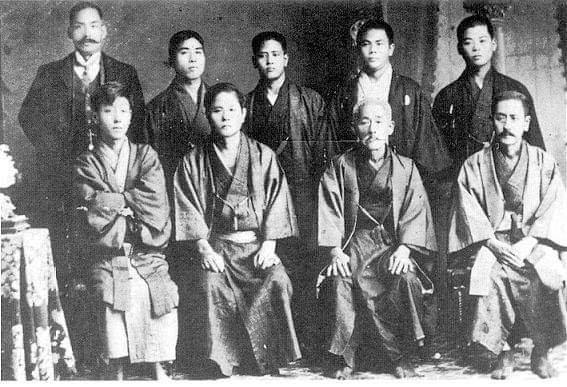
During his thirteen years in China, Higaonna Sensei mastered many traditional martial arts, such as the art of the straight sword. His technique in these various martial arts was truly art in motion. His hands and legs possessed extraordinary spring making his movements fast as lightning. People were surprised that one so small, five foot one inch, could have so much power and strength and referred to him as Kensei, meaning "sacred fists". Gradually, the art of Higaonna Sensei became known as Naha-te, "Naha" referring to the region of Naha in Okinawa and "te" meaning hand technique. He devoted his life, along with his disciple Miyagi Chojun Sensei, to the improvement and advancement of the art of Naha-te. Early in 1916, Higaonna Sensei fell ill and passed away in October 1916. Thus, the art of Naha-te was handed over from Higaonna Kanryo Sensei to his disciple Miyagi Chojun Sensei.
Higaonna Kanryo Sensei is honoured today as the founder of Naha-te karate.
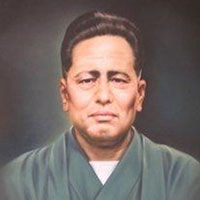
(1888 - 1953)
Chojun Miyagi was born on 25th April 1888 in Okinawa. At the age of five he became the heir to the Miyagi family. His training in karate began at the age of eleven under Ryuko Aragaki Sensei who practiced and taught Tomari-Te. When he was fourteen his teacher introduced him to Higaonna Kanryo Sensei. Chojun Sensei trained with Kanryo Sensei from 1902 until October 1916, when Kanryo Sensei passed away.
During this time he was one of the few people who could withstand the severe training given by Kanryo Sensei. After the death of his teacher, Chojun Sensei continued with his own development including trips to China and research into physiology. Chojun Sensei was instrumental in registering Karate at the Butokukai in Japan. He developed the Junbi-undo we practice today, and introduced the basic kata Gekisai Dai Ichi and Dai Ni. He also developed Tensho and a revised version of Sanchin. In addition to his personal training and development of Naha-te, Chojun Sensei spent a great deal of his time promoting the art.
In 1921, he performed a demonstration of Naha-te in Okinawa for the visiting Prince Hirohito, Emperor of Japan, and in 1925 for Prince Chichibu. Chojun Sensei had already envisioned the development of Naha-te not only in Japan but also around the world. It became increasingly important to organize and unify Okinawan karate as a cultural treasure to be passed on to future generations.
In 1926, Chojun Sensei established the Karate Research Club in Wakas-Cho. Four instructors, Chojun Sensei, Hanashiro, Motobu and Mabuni, alternately taught some preliminary exercises and supplemental exercises. Afterwards, Chojun Sensei gave talks to the students about mankind, daily life, and the samurai code of ethics in order to improve their moral development as well. In 1927, Jigoro Kano Sensei, founder of Judo, saw a demonstration of a kata by Chojun Sensei and was impressed by the advanced technique and sophistication of Naha-te. Kano Sensei´s influence allowed Chojun Sensei to perform Okinawan karate at leading Japanese Budo tournaments sponsored by the government. In 1930, Chojun Sensei performed at the Butoku-kai Tournament and then later at the Sainei Budo Tournament in 1932.
As its exposure increased, many became interested in Chojun Sensei´s style of martial arts. One of his senior students, Jinan Shinzato Sensei, gave a kata performance at a Japanese martial arts tournament. Afterwards, a master asked the name of his school. Shinzato Sensei had no answer for him, and upon his return to Okinawa he told Chojun Sensei about his encounter. In order to promote his art as well as cooperate with other schools of Japanese martial arts, Chojun Sensei decided it was necessary to name his martial art. It became known as Goju-Ryu Karate, meaning "hard and soft" taken from the precepts of traditional Chinese Kempo. He was the first among different schools of karate to name his art and in 1933 his art of Goju-Ryu was formally registered at the Butoku-kai, Japanese Martial Arts Association.
Chojun Sensei travelled extensively, spreading Goju-Ryu to mainland Japan and as far afield as Hawaii after a local Hawaiian newspaper company invited him to introduce and promote karate in Hawaii in 1934. Two years later Chojun Sensei spent two months in Shanghai, China, for further study of Chinese martial arts. In 1937, he was awarded a commendation by the Butoku-kai for his kata. Chojun Sensei continued to develop Goju-Ryu by analysing and employing scientific methods of exercise in his research. His work found many practical applications and it is no surprise to learn that many of his students were in the police force.
At this point the Second World War interceded, and the aftermath led to a prolonged period of severe hardship in Okinawa. Not surprisingly, the few students who survived the conflict could no longer train. Of those that lost their lives during the war, was Chojun Sensei´s top student Shinzato Jin´an, who was to have succeeded him.
As normal life returned again to Okinawa in the aftermath of the war, Chojun Sensei began teaching again in his garden dojo. Realising that he had so much knowledge to pass on, Chojun Sensei began grooming a new and promising young student called Anichi Miyagi (no relation) to succeed him. They trained on a one-to-one basis similar to the method he was trained by Kanryo Sensei.
Sadly, Chojun Sensei passed away on 8th October 1953 as a result of heart disease. His death at only 65 years of age and the devastation of WWII meant the style of Goju-ryu was now left in the hands of a young man, Anichi Miyagi. Chojun Miyagi's essence and influence can be found today in Dojo's in nearly every country of the world. His vision of Goju-Ryu spreading world-wide was realised just as he had foreseen.
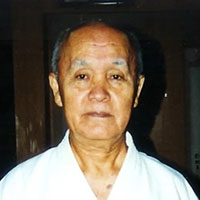
(1931 - 2009)
An´ichi Miyagi was born in Okinawa on 9th February 1931. When he was fourteen both of his parents died. He was then left with the task of raising his two younger brothers. He began his karate training with Chojun Miyagi Sensei in 1948. Such was his devotion to karate and respect for his teacher that he was taken as Uchi Deshi (special student) by Chojun Sensei.
During this time An'ichi Sensei practiced all the kata of Goju-ryu along with the basic bunkai and many of the hidden bunkai were also taught to him, he diligently practiced Hojo-Undo, Junbi-Undo and Sanchin to increase his power. This strict regime went on until the untimely death of Chojun Sensei on 8th October 1953.
After a respectful period of mourning for Chojun Sensei, it was decided to continue with the dojo in Chojun Sensei´s garden. Many of Chojun Sensei´s seniors from before the war helped. Miyazato Eichi assumed the role of dojo head and Koshin Iha was in charge of administration but An'ichi Sensei did most of the teaching. The garden dojo began to grow and amongst the new students was a young teenager by the name of Morio Higaonna. Eventually it was decided that a new permanent Dojo was needed. All the senior students, including An'ichi Sensei contributed to the construction of what is now known today as the Jundokan Dojo. An'ichi Sensei continued to teach Goju-ryu at the Jundokan and began teaching Morio Higaonna, who was now his most dedicated student, more and more. As time progressed, a difference of opinion came between the senior instructors of the new dojo and Anichi Sensei left the Jundokan never to return.
Morio Higaonna Sensei moved to mainland Japan around the same time and went on to found the International Okinawan Goju-ryu Karate-do Federation (IOGKF) with his teacher's permission and An'ichi Sensei served the IOGKF as Honorary Chairman and was the personal advisor to Morio Higaonna Sensei for many years up to his passing away in 2009. We have been very fortunate to have benefitted from this direct link back to the founder of Goju–Ryu, Chojun Sensei.
The mantle of the future development of Goju–Ryu of course passed to Morio Higaonna Sensei and now to Tetsuji Nakamura Sensei.
(1929 - 2021)
Shuichi Aragaki Sensei was born in Taiwan in 1929. His family returned to Okinawa in 1947. As a youth, Aragaki Sensei was not strong – he was small. His grandfather was Ryuko Aragaki Sensei, the first instructor of Chojun Miyagi Sensei and the one who introduced Chojun Sensei to Kanryo Higaonna Sensei. When Aragaki Sensei told his grandfather that he was interested in karate, Ryuko Sensei decided to bring Aragaki Sensei to Chojun Sensei to learn from him.
Following World War II, life was hard in Okinawa. The devastation wrought on the island by the fighting between the Americans and the Japanese left very little on which people could live. When Ryuko Sensei brought Aragaki Sensei to Chojun Sensei, Chojun Sensei was not taking any students. As he lost his top student, Jin'an Shinzato, during the war, he was focusing on teaching his only Uchideshi (private disciple) at the time, Sensei An'ichi Miyagi. But out of respect for his former teacher, Chojun Sensei accepted Aragaki Sensei as a student. Aragaki Sensei began training in 1951 at the age of 22.
When his training started, Aragaki Sensei was working as a substitute elementary school teacher. He would work during the day and go to Chojun Sensei's house every single evening to train. At first, Aragaki Sensei was not allowed to enter but was assigned to chores. Every day, he would arrive at 5 o'clock to cut firewood, draw water, and clean up the garden before starting to train at 6 o'clock. During this time, Chojun Sensei would observe Aragaki Sensei, looking at his work ethic and character.
Much of Aragaki Sensei's first instruction came from An'ichi Sensei. He and An'Ichi Sensei were the only students of Chojun Sensei, and they became like brothers. Eventually, Chojun Sensei began to train Aragaki Sensei as well. In an interview with Dragon Times, Aragaki Sensei recalls the training: "Miyagi sensei was very scary, terrifying in fact. I couldn't go near him, he had such an aura. When he practised karate his eyes glowed and emanated power. He was a bushi. His gaze was intimidating. While he was talking to me he would fix me with his eyes and I would be afraid. It was like a snake looking at a mouse, I could not move when he looked at me."
As strict as the training was, Aragaki Sensei would also tell of Chojun Sensei's generosity and kindness. He would often invite Aragaki Sensei and An'ichi Sensei for dinner after training, telling them stories and treating them like his own children.
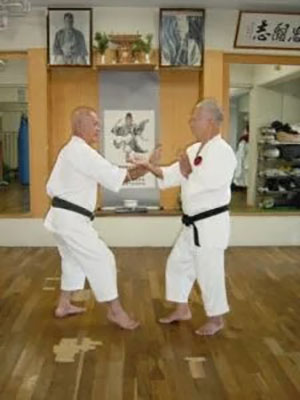
Aragaki Sensei with An'ichi Miyagi Sensei
(2003)
Aragaki Sensei trained with Chojun Sensei right up until Chojun Sensei passed away. He never stopped practicing in the traditional way. On his longevity and karate training, Aragaki Sensei had this to say: "After I started going to Miyagi sensei's dojo [my life] did change. I dedicated myself to karate. Although I worked during the day and only practised at night, even while working I thought only of karate and was greatly influenced by it. Karate made me patient, and gave me robust health. Since I joined Chojun sensei's dojo a day has never passed in my life without me thinking deeply about karate. My senior said that karate training finishes when you die. You are finished when they put you in a coffin."
We tend to focus on the direct lineage of our style and organization, but we cannot forget the enormous contributions made by Aragaki Sensei to both the IOGKF and Goju-Ryu over the course of his life. By the time of his death, Aragaki Sensei had lived a fuller life than most dared to hope for.
As one of the last surviving students of Chojun Sensei, his knowledge and advice on Goju-Ryu was of the utmost importance to the teaching of both the art and its history.
Aragaki Sensei also ensured the continuation of the IOGKF's lineage, following in his grandfather's footsteps. He was the first Goju-Ryu instructor of Nakamura Sensei. Nakamura Sensei has often said that if it was not for Aragaki Sensei, his life may have turned out very differently. Nakamura Sensei decided to move to Okinawa to train with Aragaki Sensei after he met him in Japan. Though Aragaki Sensei did not formally have a dojo at that time, he agreed to teach Nakamura Sensei privately.
Aragaki Sensei initially supported Nakamura Sensei along with teaching him, often inviting him to his home for dinner and conversation. His support allowed Nakamura Sensei to focus on training full time. Eventually, Aragaki Sensei introduced Nakamura Sensei to Higaonna Sensei and encouraged him to move to California to be an instructor at Higaonna Sensei's dojo. The rest is history.
Nakamura Sensei himself has said that much of his movement and the way he thinks developed because of his training and interactions with Aragaki Sensei. It was ultimately because of Aragaki Sensei that Nakamura Sensei found his way to where he is today. And because of this, Aragaki Sensei ensured that traditional Goju-Ryu will continue to be transmitted and taught around the world.
Aragaki Sensei passed away peacefully on August 28th, 2021 at 1:14 AM. He lived to see both hardship and good times: children, grandchildren, and great grandchildren; a world war; travel, hard work, and new friends; and the spread of an art further than anyone thought possible.

(1938)
Morio Higaonna was born 25th December 1938, and he began his karate training when he was fourteen. He studied Shorin-Ryu with his father. He was also training with a friend, Tsunetaka Shimabukuro, another Shorin-Ryu stylist. At the age of sixteen he began to train in the Goju-Ryu style on the recommendation of Shimabukuro Sensei. The year was 1955 and the young Higaonna was training in the garden dojo of the late Chojun Miyagi Shihan, his instructor was An'ichi Miyagi Sensei.
At that time the training regime was very tough and Higaonna Sensei tells us of the countless times he would practice kata or kakie training with many different opponents until he could no longer move his arms. Anyone who has trained in Okinawa will know that due to the climate this requires tremendous effort.
In 1957 the garden dojo moved to a permanent building called the Jundokan. Higaonna Sensei continued his training there, five hours every day. After his instructor, Anichi Miyagi Sensei moved away to work on an American oil tanker Higaonna Sensei gained a place at the Takushoku University in Tokyo, it was around this time that the first official Dan grading was organised.
Higaonna Sensei was awarded 3rd Dan. The year was 1960. It was in Tokyo that Higaonna Sensei taught at the famous Yoyogi Dojo. Many thousands of students passed through this dojo and the legends of Higaonna Sensei abilities began to grow. Don Dreager was a western martial artist who travelled all over Japan documenting Masters for all martial arts styles. He made comments such as 'There is no one here like Higaonna Sensei' & more famously, 'Higaonna Sensei is the most dangerous man in Japan in a real fight'.
During the late sixties and early seventies Higaonna Sensei began travelling to several of the countries that were practicing Okinawa Goju-Ryu. He was invited to perform a demonstration at the World Karate Championships in Paris in 1972 and his reputation as one of the strongest Goju-Ryu practitioners in the world was growing further.
In 1979 in Poole, England with the help of his senior international instructors the IOGKF was formed. The primary objective of the IOGKF remains the preservation of traditional Goju-Ryu Karate as taught by its founders, and it is now a proud member of the Nihon Kobudo Kyokai (Japan Traditional Martial Arts Association).
Higaonna Sensei spent time living in the United States of America where he established his headquarters in San Marcos for some time, before eventually returning to Okinawa, Japan where he currently resides. From that time to this, Higaonna Sensei has maintained his own strict training regime and continues to research the original kata and training methods of Goju-Ryu.
In July 2012 after over 35 years as the head of the IOGKF, Higaonna Sensei stood back to take an advisory role within the organisation and passed the title of Shuseki Shihan (Chairman and Chief Instructor) to Sensei Tetsuji Nakamura, selecting him to lead IOGKF into the next generation.
In 2013 Higaonna Sensei received an award from the Okinawan Government naming him as a living cultural treasure for the Island for his lifetime's work to spread Okinawan Goju-Ryu to the world as well as preserving it forever in its homeland.
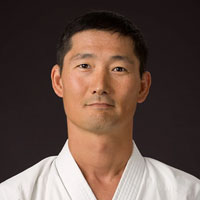
(1965)
Tetsuji Nakamura, is the man entrusted by Sensei Higaonna to fulfil a lifetime's duty of protecting traditional Goju-ryu and passing it on to the next generation. In July 2012, Sensei Higaonna announced to his senior students around the world that he would be passing the flame of Goju-Ryu onto Sensei Nakamura – a man who has been one of his closest and loyal students.
At the age of only 47 years old, Sensei Nakamura claimed that as he is young and that he still has a lot to learn as a Karate-ka; demonstrating the kind of humility we have come to expect from his own instructor. He committed himself to spend the rest of his life to further protect and develop Okinawan Goju-ryu Karate-do.
BEGINNINGS
Sensei Tetsuji Nakamura had no idea that when he began martial arts training at the age of 12, that his journey would become as serious of a life's pursuit as it has. He was born in Osaka, Japan on April 3rd, 1965 and took up Judo at the age of 12, beginning the practice of Karate in Senior high school at the age of 15. He continued his Judo practice for six years, achieving the level of 2nd Degree Black belt in the art. His commitment to his martial arts training began at an early age, with him training in Judo a minimum of five times per week.
As he entered senior high school he experienced his first introduction to Karate, practicing in a Goju Kai club for three years. Although he admits that his focus was more on Judo at this time, there was obviously a passion and appreciation for Karate that led to him joining another Karate school upon attending university.
Sensei Nakamura attended Kagawa university and while there began training with another Goju style club. The training was physical, but focused on a lot of free fighting as the club was full of eager young men out to prove themselves on the dojo floor. Sensei Nakamura was one to hold his own and when he told the club instructor that he was heading with some friends to vacation on Okinawa during his university break, his instructor insisted he should get in contact with one of his own Sensei's.
Always the loyal student, upon arriving in Okinawa Sensei Nakamura telephoned a man named Shuichi Aragaki. Unto his knowledge, Sensei Nakamura called a Karate Master who was one of only two private students of the Goju-ryu style founder, Bushi Chojun Miyagi, following the devastation of World War II. Aragaki Sensei was very kind to this young stranger and invited him to his home for dinner. During the meal, Aragaki Sensei told him about his training with Chojun Miyagi Sensei and what true karate was all about. After Nakamura Sensei returned to the mainland, he started thinking about Aragaki Sensei's stories often. He decided to return to Okinawa and visit Aragaki Sensei one more time to find out more about his Karate from him before he graduated University.
Upon returning to Okinawa, Sensei Nakamura contacted Aragaki Sensei and visited with him again. The Karate master then took the young man and led him to the Uehara dojo in Okinawa. Following introductions, training began. The aging Master asked the young Nakamura Sensei to punch him. Realising the age difference, a Sensei Nakamura punched slowly for Master Aragaki who was taken aback. He asked again for the young man to punch him with full power. Sensei Nakamura charged in and quickly found himself on the ground numerous times. He later explained that each of Master Aragaki's punches landed precisely on vital areas each time and that he felt as if he could have been killed by the Sensei had the choice been made. Training eventually moved on to Kata training. After the Master saw the performance of his Kata, he asked him 'what is this? This is not traditional Karate.'
The meeting ended, but those words continued to echo within Sensei Nakamura's mind, especially when returning to the university dojo. Later the same year, Sensei Nakamura graduated from university with a law degree and a degree in politics. He had hoped to become a high school teacher, or business man, which had changed from his original choice of wanting to be a policeman in High School. Regardless, Sensei Nakamura had the education and degrees to enter any occupation that he chose. But with the words of Master Aragaki rolling through his head again and again, he decided he must return to Okinawa.
As you can imagine after achieving such high-profile degrees at a university level, his mother was not impressed with his decision to move to Okinawa to practice Karate. With all this sitting upon his young shoulders, Sensei Nakamura still decided to pursue Master Aragaki and called to tell him he was returning to Okinawa.
Arriving at the Master's house, Sensei Aragaki explained to the young man that he did not have time to instruct him. Instead, he took the young Sensei Nakamura to the legendary Higaonna Dojo, the Okinawan home of the famous World IOGKF Chief Instructor, Sensei Morio Higaonna. The World Master was living in America at the time, but Master Aragaki had a plan for the young man. He showed Sensei Nakamura how to use traditional supplementary training tools (Hojo Undo), such as Chishi, Nigiri Game and Kongoken. He told Sensei Nakamura, "you must do this every day, train hard'.
In the time of Goju-ryu founder Bushi Chojun Miyagi, a student who applied to the dojo was subjected to several years of Hojo Undo and Sanchin training. If the student had the patience and the focus to survive this ordeal, then he would be taught Kata and more about Goju-ryu. Although this Hojo Undo still holds a large part in the training of a Goju-ryu Karate-ka, it is an old custom that today is no longer set in stone, in an attempt to ensure Karate remained popular. Karate was already popular with Sensei Nakamura and Master Aragaki recognized this to the point where he subjected him to the same ordeal as that of a new student some fifty years before.
Determined to find true Karate, Sensei Nakamura listened to Sensei Aragaki and practiced hard every day. However, after a few weeks Master Aragaki had not visited the Dojo. Sensei Nakamura would often have dinner at the Masters house on the weekend, Aragaki Sensei gave him lectures about Karate and life, but his visit to the Dojo was never mentioned. Training continued and the weeks continued to pass, still no Master Aragaki.
It was not until six months had passed, that Master Aragaki had confirmed that Sensei Nakamura had the drive and discipline of a student from the olden days. He went to the Dojo and began to train Sensei Nakamura once or twice per week. First, he taught him Sesan Kata, followed by other Goju-ryu Kata; Sesan Kata is Nakamura Sensei's favourite Kata to date.
Sensei Nakamura continued to train and when Master Higaonna returned to Okinawa in 1991 to visit and train at his Okinawan Dojo, he immediately identified the young man's ability and training style. When he managed to win the IOGKF World Championships Hard style free sparring (Irikumi Go) and 2nd place in the Kata competition in the same year, Master Higaonna saw the value in Sensei Nakamura and asked him to come to America with him so he could continue his training. Very nervous, Sensei Nakamura told Master Aragaki of Higaonna Sensei's invitation and he urged him to go. 'Higaonna Sensei is the best Master in the world. You should go learn from him.'
MOVE TO THE UNITED STATES OF AMERICA
So once again, Sensei Nakamura packed up his life for Karate and set off to America to pursue training under his new Master. When first arriving in California, Sensei Nakamura was living with Master Higaonna and his family, becoming an Uchi Deshi (literally a house student). He would train every morning with the Goju-ryu Master in his garage and then again with him in the afternoon and evening at his Dojo in San Marcos – the Institute of Traditional Karate. Class training with Master Higaonna is physical as it is, let alone being one on one with him and having no place to hide or leave room for error. The training was gruelling and helped forge Sensei Nakamura into the Karate warrior he would become.
He was soon promoted to assistant instructor at the San Marcos dojo and spent time assisting Higaonna Sensei's wife, Alanna, in the IOGKF office, who was administrative director of the International Federation at the time; a role he would one day inherit from her. Sensei Nakamura was also responsible for teaching junior classes and when Higaonna Sensei was away teaching overseas Gasshuku's he would instruct the senior classes.
As anyone who has had the fortune to train with Master Higaonna knows any session under him drastically improves your Karate in all aspects, Sensei Nakamura has spent years continuously training under the Master and benefiting from his knowledge and traditional methods. This was proven when he again claimed gold at the 1994 IOGKF world championships in the free fighting competition (Irikumi Ju) and Kata. In 1995 his name became well known among the IOGKF and Goju-ryu world as he was direct assistant to Master Higaonna in his legendary video documentary ‘Power Training'.
BACK TO JAPAN
In the same year, Master Higaonna realised the need for mainland Japan to have a strong headquarters and decided he would return to Tokyo to establish the Ryubukan, a Dojo
that would become the centrepiece of Goju-ryu in Japan. He asked Sensei Nakamura to accompany him and the two moved to Tokyo together.
ONLY THE TRADITIONAL PATH
In 1994 Tetsuji Nakamura Sensei was 29 years old and had just accomplished his goal of winning the IOGKF World Championships free fighting category – a task he felt pressured to accomplish having been an instructor at the IOGKF Honbu Dojo. But as he lay in bed the next morning, he thought to himself ‘am I really the best in the world?' His answer to himself was no. Even though he had achieved an impressive win of the entire tournament, he still felt that compared to many of the IOGKF International senior instructors, he was only starting out as a good traditional martial artist.
It was at this point that he decided to end his competitive career to focus solely on Traditional Okinawan Goju-ryu Karate-do. He changed his personal training schedule to reflect a greater emphasis on Hojo Undo (supplementary training specific to Goju-ryu) and Sanchin practice. He felt his Karate, strength, power and speed improved drastically as he moved into his thirties.
His commitment to traditional Karate made returning to Japan to assist Master Higaonna in establishing the Ryubukan Dojo a little easier. Master Higaonna decided a strong centrepiece for Goju-ryu in Japan was needed and in turn he established the Dojo in the capital of the land of the rising sun. Sensei Nakamura was training daily and teaching at the Ryubukan as an assistant instructor. He stayed in Tokyo for three years to help Master Higaonna to establish the Japanese Headquarters.
In 1997, Sensei Nakamura moved to Canada to help his friend, Jim Marinow (former IOGKF Canada Chief Instructor). The two had practiced together in California under Master Higaonna in the early 1990s. In 2000, he married Rania and they had their first baby, Emilie, in 2002. In same year, Mrs. Alanna Higaonna retired from her position as an administrative director and Master Higaonna appointed Sensei Nakamura as the new person to oversee the running of the International Federation. Nakamura Sensei moved back to Okinawa with his wife Rania and three-month-old daughter for one year, so he could take over the task of administrative director for the IOGKF. He then moved back to Canada in 2003, as Jim Marinow left the IOGKF in 2002. It was here that Master Higaonna appointed Sensei Tetsuji Nakamura as Chief Instructor for IOGKF Canada.
When Sensei Nakamura declared to his parents that his intentions were to follow his Karate calling after he had finished his university degree, they were not overly impressed. His mother did not speak to him for a great length of time. But when his parents travelled to Canada in 2000 for a vacation, they quickly realised the happiness and the life that Karate had given their son. From this point on, they accepted and supported Sensei Nakamura's quest to become the best person he could be and to spread Goju-ryu across the world.
IOGKF Canada really began to grow at Sensei Nakamura's hand and at the end of 2003 he decided that it was time for him to establish his own Dojo. This was the beginning of Shudokan, now one of the world's most popular Goju-ryu Dojo's. For a number of years, he taught out of a purpose-built Dojo, but as his popularity grew, he was soon dealing with over 180 students training regularly, it was decided that a bigger venue was needed. In 2011, a labour of love was created. A very large two-story mechanics garage was transformed into the new Shudokan Dojo. Students from all over Canada and World assisted in building the new home of IOGKF Canada and soon the IOGKF World.
Sensei Nakamura's excellent rapport with instructors and students all across the globe, coupled with his rapidly growing International following and his understanding and respect for preserving traditional Goju-ryu; saw Higaonna Sensei appoint him as IOGKF World Vice-Chief Instructor in 2008 and also as an executive committee member for the World Federation.
Sensei Nakamura's role in how Goju-ryu was protected and spread to the World was now becoming larger and he began to travel more and more, having visited over 30 countries in recent years. His humble nature, approachability and sincere desire to want to help every person improve themself through Karate brought exciting prospects to an international organisation which was well past its 30th anniversary.
As the 2012 IOGKF World Budosai approached, Master Morio Higaonna took the time to reflect on his role in traditional Goju-ryu. Now in his mid-seventies, Master Higaonna had fulfilled the wishes of style founder Bushi Chojun Miyagi and spread Goju-Ryu to the four corners of the globe. From South Africa to Canada, Britain to Australia & New Zealand, America to the middle east – the IOGKF has an extremely strong foundation in over 60 countries. Master Higaonna then decided he had to look to the future.
A meeting was called for all country chief instructors during the Budosai event. Master Higaonna announced to his most senior students, many of whom now respected international instructors in their own right, that he would be stepping back from his role as World Chief Instructor to take up an advisory position within the Federation he had founded. He then moved to announce that Sensei Tetsuji Nakamura would succeed him as the new IOGKF World Chief Instructor and charged him with the responsibility to pass Goju-Ryu onto the next generation. This announcement was well received by all attendees at the World Budosai and news quickly spread across the globe.
During the same week, Sensei Nakamura achieved the rank of 7th degree Black Belt from Sensei Higaonna. When this was announced to the world it was met with thunderous applause. When Chojun Miyagi Sensei first entrusted Goju-ryu to a young man named Anichi, he told him he had given him a precious treasure, one which he must protect and never lose. Sensei Higaonna had now given the same to Sensei Tetsuji Nakamura and the new IOGKF Chief instructor understood the importance of what he had given. "I feel a great responsibility to be chosen as the leader of my generation."
Today, Sensei Tetsuji Nakamura still resides in Canada with his wife Rania and two daughters, Emilie & Sophia. He is a caring family man and dedicates his time between his home life and Karate practice and instruction. He will still tell you today that he is not the best in the world. However, it is this humility, coupled with the thousands of hours of sincere & dedicated practice and research that really do make Sensei Tetsuji Nakamura one of the best in the World. He once remarked that he doesn't think he can ever reach Master Higaonna's level, but that he will never stop striving to do so. With this passion and spirit towards training and with the backing of the World, the future of Goju-ryu is safe and will continue to prosper under his leadership.
In 2020 Nakamura Sensei's travels and Gasshuku came to an abrupt halt due to the worldwide pandemic. Nakamura Sensei remained true to his mission by providing a venue for IOGKF members worldwide to continue their training. Within days, under his guidance prerecorded videos from instructors around the globe were being shared with IOGKF members. And shortly thereafter, he orchestrated several gasshukus featuring senior instructors of IOGKF from various countries. He was truly a model of one of the IOGKF precepts, “Never give up”. These events provided IOGKF members around the world with the opportunity to train with many of the top IOGKF instructors who they may never have had the chance to do before. The members remained connected and they continued to work on improving their skills all in the safety of their own homes.